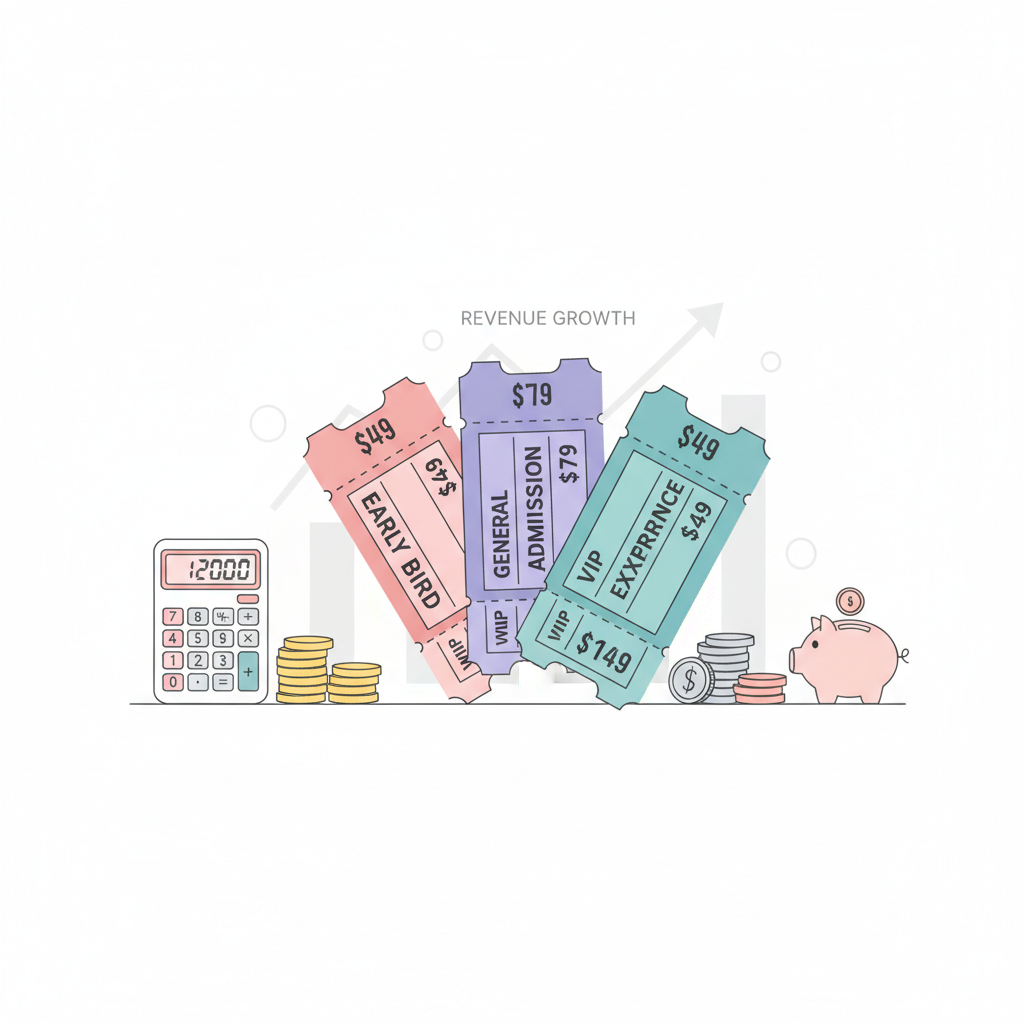
Event Pricing Strategy: How to Price Your Tickets for Maximum Revenue
Emily Thompson
Pricing your event tickets is part math, part psychology, and part gut feeling. Get it right, and you maximize revenue while filling seats. Get it wrong, and you're either leaving money on the table or scaring away attendees with sticker shock.
In 2026, ticket pricing has gotten more complex — and more important — than ever. With the global events industry projected to reach $2.19 trillion by 2028, organizers face rising competition, more sophisticated audiences, and a growing backlash against hidden fees. The platforms that thrive are the ones that combine smart pricing strategy with radical transparency.
According to a 2025 Eventbrite study, 68% of millennials and Gen Z say hidden fees are their #1 frustration when buying event tickets. A separate TickPick survey found that 63% of buyers would abandon a purchase if additional fees were added at checkout. That's not a minor annoyance — it's a conversion killer.
Whether you're hosting a family reunion, a church event, a community festival, or a paid workshop, this guide breaks down the psychology, mathematics, and practical strategies to price your tickets for maximum revenue and attendance.
- The big idea: Pricing is the single biggest lever you have on event revenue — more than marketing, more than venue selection.
- The hidden fee problem: 63% of buyers abandon at checkout when surprise fees appear.
- The transparency win: Events with all-inclusive pricing see 17% higher conversion rates.
- Gatheroo's advantage: Transparent pricing with no hidden fees — what you set is what attendees pay.
The Psychology of Ticket Pricing
Before we get into numbers, you need to understand how people actually make purchasing decisions. Pricing isn't just about covering costs — it's about perception, value signaling, and emotional triggers.
1 Anchoring: The First Number Sets the Frame
Anchoring is one of the most powerful pricing psychology tools. The first price a potential attendee sees becomes their mental "anchor" — the reference point for everything that follows. If you show a $75 VIP ticket first, your $35 general admission suddenly looks like a bargain.
Research from Princeton's behavioral economics lab found that anchoring effects can influence purchasing decisions by up to 30%. That means simply reordering how you present ticket tiers can meaningfully change your revenue mix.
Practical tip: Always list your most expensive tier first, even if few people buy it. It makes your mid-tier option — the one you actually want most people to choose — feel like a smart middle ground.
2 The Decoy Effect: Steering Toward Your Target Tier
The decoy effect is a classic pricing strategy where you introduce a third option that makes your preferred option look like the best deal. The famous example comes from The Economist magazine: a print-only subscription for $125, a web-only subscription for $59, and a print + web subscription for $125. The print-only option is the decoy — it makes print + web look like an incredible value, and 84% of subscribers chose it.
For events, this means creating three tiers where the middle one is clearly the best value. For example: General Admission at $25, VIP at $60, and VIP + Backstage Pass at $65. The $60 VIP becomes the decoy, and most people jump to the $65 option because the $5 upgrade feels like a steal.
3 Price Elasticity: Knowing Your Audience's Limits
Price elasticity measures how sensitive your audience is to price changes. A 10% price increase that drops attendance by 5% means your event is inelastic — you can raise prices and still make more money. But if that same 10% increase drops attendance by 20%, your event is elastic — lower prices might actually generate more revenue.
General rules of thumb from 2025 industry data:
- Niche workshops and professional conferences — inelastic (attendees pay for specialized value, price increases rarely hurt attendance significantly)
- Community and family events — moderately elastic (price-sensitive but willing to pay for quality experiences)
- Free or low-cost community gatherings — highly elastic (small price changes dramatically affect turnout)
- Premium concerts and galas — inelastic (high-value audiences expect premium pricing)
4 The Charm Pricing Myth: When $19.99 Beats $20
Charm pricing — ending prices in 9 or 99 — is everywhere, and for good reason. A 2005 University of Chicago study found that items priced at $39 outsold identical items priced at $34, simply because the "39" felt significantly cheaper to buyers. The left-digit effect makes $19.99 feel much closer to $10 than to $20.
However, there's a nuance: charm pricing works for impulse purchases and consumer events, but it can undermine perceived value for premium experiences. If you're selling a $500 gala ticket, pricing it at $499.99 makes it feel cheap rather than premium. Match the pricing style to your event's positioning.
Pricing Models That Actually Work
5 Tiered Pricing: Give People Choices
Tiered pricing is the single most effective pricing model for events. By offering 2-4 tiers, you capture different audience segments while guiding most buyers to your target price point. According to a 2025 Price Intelligently report, events with 3 ticket tiers generate 28% more revenue than those with a single price point.
The standard tier structure:
- Early Bird (15-20% off) — Creates urgency, rewards early commitment, and generates early cash flow
- General Admission — Your target price, the tier most people buy
- VIP / Premium — 50-100% premium for exclusive perks (preferred seating, meet-and-greet, swag bag)
6 Early Bird Pricing: The Urgency Multiplier
Early bird pricing isn't just about giving a discount — it's about creating urgency and momentum. When you set a deadline (e.g., "First 50 tickets at $15, then $25"), you give people a reason to act now rather than later. This combats the #1 enemy of event sales: procrastination.
According to Eventbrite's 2025 data, events using early bird pricing sell 42% of their tickets in the first two weeks, compared to 18% for events without early bird tiers. That early cash flow helps with venue deposits, marketing, and production costs — and the momentum makes the event feel popular, which drives even more sales.
Best practices for early bird pricing:
- Limit by quantity (e.g., "First 30 tickets") rather than just time — creates scarcity
- Make the discount meaningful (15-25% off, not just 5%)
- Show the regular price next to the early bird price so the savings are obvious
- Send a countdown reminder 48 hours before the early bird ends
7 Dynamic Pricing: The Airline Model
Dynamic pricing — where ticket prices increase as the event date approaches or as inventory decreases — is borrowed from airlines and hotels. The logic is simple: the closer to the event, the more committed buyers are, and the more they're willing to pay. This captures maximum revenue from last-minute buyers while rewarding early commitment.
A 2025 Splash study found that events using dynamic pricing generated 23% more revenue than those with flat pricing, even when attendance was similar. The key is transparency — make it clear that prices will go up, so attendees are incentivized to buy early.
8 Pay-What-You-Want: The Community Model
Pay-what-you-want (PWYW) pricing sounds risky, but it can be surprisingly effective for community events, charity fundraisers, and events building a new audience. Research from the Journal of Marketing found that PWYW events actually generate 14% more revenue on average than fixed-price events with the same attendance — because some attendees pay more than the suggested price out of generosity.
The key is to provide a "suggested price" anchor. Without it, people default to paying very little. With a visible suggested price of $20, the average payment tends to land around $15-18, which is often higher than what you'd have charged.
The Hidden Fee Problem (And How to Fix It)
If there's one thing that destroys ticket sales faster than overpricing, it's hidden fees. The data is staggering:
- 63% of buyers abandon their purchase when surprise fees appear at checkout (TickPick, 2025)
- 71% of consumers say they'd be more likely to buy if the full price was shown upfront (Baymard Institute)
- Eventbrite's average fee adds 8-15% on top of the ticket price, including a per-ticket service fee and a payment processing fee
- Ticketmaster's fees can add 27-40% to the face value of a ticket, sparking widespread consumer backlash
The solution is simple: all-inclusive pricing. Show the full price — including all fees — from the very first moment an attendee sees the ticket. Events that switch to all-inclusive pricing see an average 17% increase in conversion rates, because buyers trust the price they see and don't feel deceived at checkout.
Gatheroo advantage: Gatheroo shows transparent, all-inclusive pricing on every event page. What you set is exactly what attendees pay — no surprise service fees, no hidden processing charges. This builds trust and drives higher conversion.
Why This Matters for Small Organizers
If you're organizing a family reunion, a church event, or a community gathering, you might think pricing strategy doesn't apply to you. But it absolutely does — and the stakes are even higher.
Small organizers typically operate on tight margins. Every dollar matters. When you're selling $15 tickets to a community potluck, losing 5 buyers to hidden fee abandonment means $75 less in revenue — and 5 fewer people who showed up ready to participate and contribute.
For church events and community organizations, pricing isn't always about maximizing revenue. Sometimes it's about covering costs while keeping the event accessible. That's where tiered pricing and "pay-what-you-can" models shine — they let those who can afford to pay more subsidize those who can't, without anyone feeling awkward about it.
How Platforms Compare on Pricing
| Feature | Gatheroo | Eventbrite | Ticketmaster |
|---|---|---|---|
| Per-event cost | $1 (flash sale) | $0 + fees | Varies |
| Service fee per ticket | $0 | 8-15% of ticket price | 27-40% of ticket price |
| Hidden fees at checkout | None | Yes (service + processing) | Yes (multiple layers) |
| Lifetime unlimited plan | $9.99 | Not available | Not available |
| Free events allowed? | Yes, unlimited | Yes (limited) | No |
How to Set Your Ticket Price: Step by Step
Calculate your total costs — venue, food, supplies, marketing, speaker fees, and a 10% contingency buffer.
Estimate realistic attendance — don't be optimistic, be honest. Use past events or comparable events as a baseline.
Divide total costs by estimated attendance to get your break-even price per ticket.
Add your desired profit margin — typically 20-40% above break-even for paid events.
Set your early bird price at 15-20% below your general admission price.
Create a VIP tier at 50-100% above general admission with meaningful perks.
Display all-inclusive pricing — no hidden fees, ever. What attendees see is what they pay.
Monitor sales velocity in the first 72 hours. If sales are slow, consider a limited-time discount or additional marketing rather than cutting the base price.
The Bigger Picture
Pricing your event well isn't about squeezing every last dollar out of your attendees. It's about finding the sweet spot where your event is sustainable, your attendees feel they got great value, and your community keeps coming back.
The most successful event organizers treat pricing as an ongoing experiment. They test different tiers, monitor what works, and adjust. They're transparent about costs and fees. And they never forget that a sold-out event at a fair price beats a half-empty event at a premium price — every single time.
At the end of the day, your attendees are paying for an experience. Price it fairly, be transparent, and deliver more value than they expected. That's the strategy that never goes out of style.
Want to save this guide for later?
Related Articles

15 Best Ways to Market and Sell Out Your Event in 2026
Selling out an event is every organizer's dream. Here are 15 proven, battle-tested strategies to maximize ticket sales and achieve sold-out status — from high-converting event pages to social proof, influencer partnerships, and FOMO tactics that actually work in 2026.
Building Community Through Local Events: A Practical Guide for 2026
One-off events are great. But real community — the kind where people show up for each other — is built through consistency. Here's how to host recurring local events that turn strangers into neighbors and neighbors into family.

How to Plan the Perfect Family Reunion: Complete Guide
Planning a family reunion for 50+ people? This step-by-step guide covers date selection, venue options, multi-generational activities, food quantities, budget breakdowns, and communication timelines to keep everyone — from toddlers to grandparents — happy.